
ASEAN NCAP Withdraws 5 Star Proton X90 Rating, New 2026 Model Only 1 Star
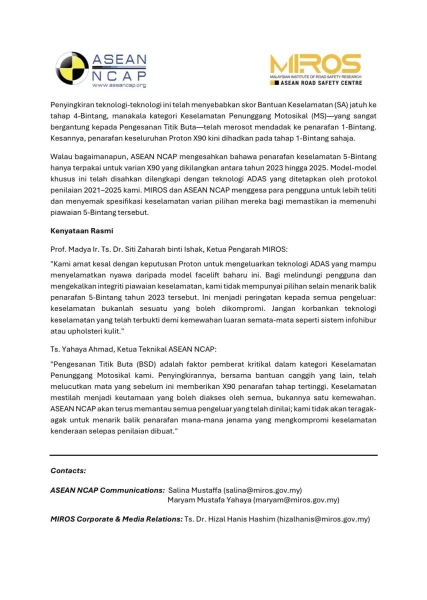
The New Car Assessment Program for Southeast Asian Countries (ASEAN NCAP) has officially revoked the 5-star safety rating for the Proton X90 following the launch of the 2026 facelift model.
Through statements ASEAN NCAP on Facebook, a new rating found that the vehicle now only deserves a 1-star rating due to the removal of several key driver assistance technologies.
It is understood that most of the Proactive Driver Assistance (ADAS) technology previously available on models evaluated in 2023 has been removed from the latest model.
Some security features that are no longer offered include:
-
Autonomous Emergency Brake (AEB)
-
Forward Violation Warning (FCW)
-
Lane Departure Warning (LDW)
-
Lane Keeping Assistance (LKA)
-
Rear Cross Traffic Alert (RCTA)
-
Blind Spot Detection Technology (BST)
Previously, in 2023, the Proton X90 received a 5 star rating based on the ASEAN NCAP 2021-2025 protocol with an overall score of 83.79 points.
These scores include high performance in several categories such as Adult Passenger Protection (37.75 points), Child Passenger Protection (17.79 points), Safety Assistance (15.71 points) and Motorcyclist Safety (12.50 points).
Ratings may be lowered if safety performance is poor
However, after reviewing the specifications of the 2026 facelift model, ASEAN NCAP found that the reduction in safety technology caused the Safety Assistance category score to drop to 4 stars, while the Motorcycle Rider Safety category dropped to 1 star due to its heavy reliance on the blind spot detection system.
As a result, the Proton X90’s overall rating is now limited to 1 Star level, the statement said.
Under the ASEAN NCAP protocol, the overall rating can be lowered if a vehicle performs poorly in one of the key safety categories to ensure overall protection for road users.
MIROS Director General Siti Zaharah Ishak said that his party regretted the manufacturer’s decision to discard safety technology that had the potential to save lives.
Meanwhile, ASEAN NCAP Technical Head Yahaya Ahmad explained that the blind spot detection system is an important factor in assessing the safety of motorbike riders.
ASEAN NCAP also explained that the Proton
PakarPBN
A Private Blog Network (PBN) is a collection of websites that are controlled by a single individual or organization and used primarily to build backlinks to a “money site” in order to influence its ranking in search engines such as Google. The core idea behind a PBN is based on the importance of backlinks in Google’s ranking algorithm. Since Google views backlinks as signals of authority and trust, some website owners attempt to artificially create these signals through a controlled network of sites.
In a typical PBN setup, the owner acquires expired or aged domains that already have existing authority, backlinks, and history. These domains are rebuilt with new content and hosted separately, often using different IP addresses, hosting providers, themes, and ownership details to make them appear unrelated. Within the content published on these sites, links are strategically placed that point to the main website the owner wants to rank higher. By doing this, the owner attempts to pass link equity (also known as “link juice”) from the PBN sites to the target website.
The purpose of a PBN is to give the impression that the target website is naturally earning links from multiple independent sources. If done effectively, this can temporarily improve keyword rankings, increase organic visibility, and drive more traffic from search results.
